You Have a Face. You Have a Story. You Just Do Not Have to Be on Camera Anymore.
News & Insights
5 Min Read

Let's be honest about something.
Most people who have something valuable to say never say it publicly. Not because they lack the ideas. Not because they lack the knowledge. Because they cannot stand the idea of being on camera.
The lighting is wrong. The background is wrong. They say 'um' too much. They hate how their voice sounds. They record twelve takes and use none of them. Sound familiar?
Here is the part nobody tells you: in 2025, being on camera is optional. Your presence is not.
This is exactly what a realistic talking AI avatar changes. And it is exactly what Adori AI was built to make possible for anyone who has ever had a message worth sharing but could not get past the camera to share it.
What Is a Realistic Talking AI Avatar, Actually?
A realistic talking AI avatar is a digital version of a person or persona that speaks, moves, and presents content on your behalf. Not a cartoon. Not a robot. A visually credible, naturally-spoken on-screen presence that looks and sounds like a real presenter.
The best ones do not look generated. They hold eye contact. They gesture naturally. They pace their speech the way a real person does. They can speak in multiple languages, adapt to different tones, and maintain a consistent visual identity across every video you ever make.
What makes this different from a voiceover or a slideshow is the human element. Viewers respond to faces. They trust faces. They remember faces. A realistic talking AI avatar gives your content that human presence without requiring you to show up in front of a camera every time you have something to say.
The average content creator spends 4.2 hours per video on filming and editing alone. With a realistic talking AI avatar, that drops to under 25 minutes. The content stays the same. The time investment does not. |
Who Is Actually Using AI Avatar Generators Right Now?
This is not a tool for tech enthusiasts or early adopters only. The people using an AI avatar generator today are exactly the people you would not expect to be early users of any technology.
The Expert Who Hates Being on Camera
A physiotherapist in Bangalore with 14 years of clinical experience. She knows more about lower back rehabilitation than most people will ever need to know. She has been meaning to start a YouTube channel for three years. She has recorded exactly zero videos because she cannot get through the first 30 seconds without stopping herself.
She uses Adori AI's realistic talking AI avatar feature. She writes her content. The avatar presents it. Her channel has 4,200 subscribers in five months. She has not appeared in a single frame.
The Educator Who Needs to Scale
A corporate trainer who runs leadership workshops for mid-sized companies. His sessions are excellent. The problem is he can only be in one room at a time. Using an AI avatar generator, he has converted his best session content into video modules that his clients now use for onboarding across multiple offices simultaneously. He teaches once. The avatar teaches at scale.
The Small Business Owner Building a Brand
A bakery owner in Pune who started posting educational content about sourdough. She used a realistic talking AI avatar to create a weekly 'bread tip' series without ever setting up a camera or ring light. Three of her videos crossed 50,000 views. One of them was seen by a food brand that approached her for a collaboration.
68% Camera Anxiety of professionals say camera anxiety stops them creating content | 3x Watch Time videos with a human face get 3x longer average watch time | 25 min Avg Production average time to produce an avatar video with Adori AI |
How the AI Avatar Generator in Adori AI Works
You do not need to understand the technology to use it. But here is what is happening under the surface so you can see why it produces the quality it does.
When you write your content in Adori AI and choose to present it using a realistic talking AI avatar, the platform does several things at once. It takes your script, breaks it into natural speech segments, and maps them to a selected avatar's facial movements, lip sync, and body language. It matches vocal pacing to the natural rhythm of spoken sentences. It syncs the avatar's delivery to the scene-by-scene visual content it is generating around your text.
The result is not a talking head over a blank background. It is a produced video where your avatar presents your content in context, surrounded by relevant visuals, with captions, transitions, and professional pacing built in.
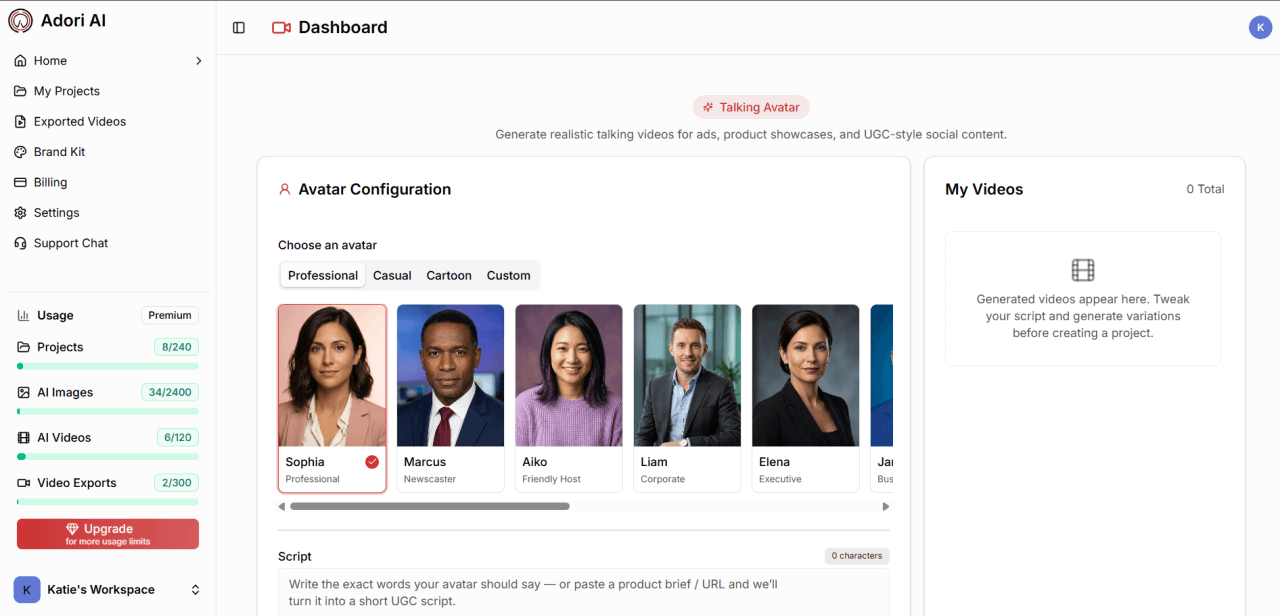
You choose the avatar that fits your brand. You choose the voice. You adjust the tone. You export. That is the complete workflow.
The Question You Are Probably Asking: Will It Look Real?
This is the right question. And the honest answer is: it depends on what you compare it to.
Compared to a poorly lit, nervously delivered selfie video recorded on a kitchen table at 11pm? A realistic talking AI avatar wins every time. Compared to a professionally produced video with a full crew, studio lighting, and a media-trained presenter? The gap is smaller than you think, and closing fast.
What matters practically is this: viewer trust is built on consistency, clarity, and confidence. A realistic talking AI avatar delivers all three, every video, without a bad hair day, without vocal fry from a long week, without the awkward pause at minute two where you lost your train of thought.
For the vast majority of creators, educators, and professionals who are choosing between a high-quality avatar video and no video at all, the avatar wins before the debate even starts.
"I spent two years knowing I should be creating content and convincing myself I would start 'when I was ready'. I was never going to be ready for the camera. Adori AI gave me a way to show up without showing up. My first video got 11,000 views. I have not looked back."
Nikhil R., Independent Financial Advisor, Hyderabad
Five Things a Realistic Talking AI Avatar Does That a Voiceover Cannot
1. It creates trust through a face. Viewers are wired to respond to human faces. A face-forward video builds credibility in a way that a voiceover on a slideshow never quite matches. The avatar gives your content a presence, not just a sound.
2. It holds attention longer. Average watch time on face-forward video is significantly higher than on narrated slides. When there is a face to follow, viewers stay in the video.
3. It creates a consistent brand identity. Your avatar looks the same in every video. Same face, same style, same energy. That visual consistency builds brand recognition faster than a rotating cast of different filming environments and on-camera personas.
4. It scales without you. You can produce ten videos in the time it used to take you to film one. The avatar does not need breaks, retakes, or motivation. You write. It presents.
5. It removes the camera as a barrier entirely. This is the one that matters most. Every creator who has ever quit before they started because of camera anxiety now has a route that bypasses the barrier completely.
What Adori AI Gives You That Other Tools Do Not
There are other AI avatar generators on the market. What makes Adori AI different is that the avatar is not a standalone feature. It is part of a complete content production system.
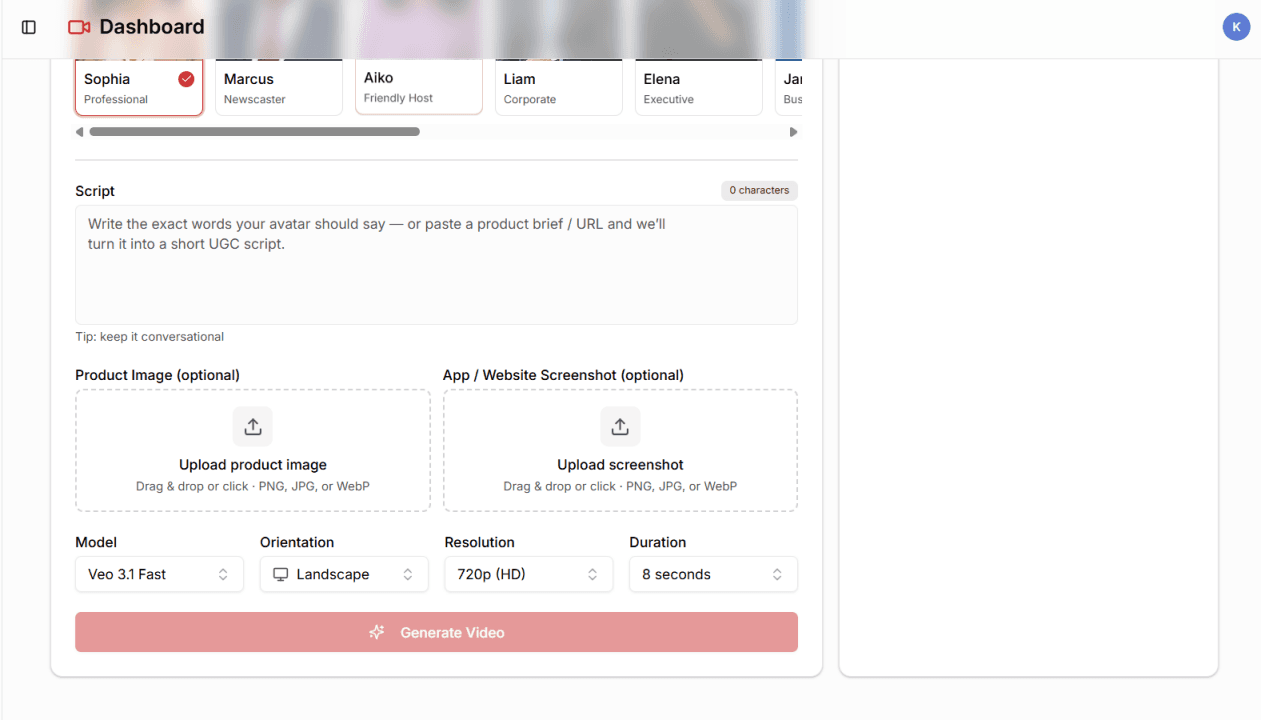
You write your text. Adori AI builds the video around it: the visuals, the voiceover, the captions, the transitions. The avatar is the presenter within a fully produced piece of content. You are not building a talking head and then figuring out what to put around it. You are producing a complete video in a single workflow.
For creators, educators, and professionals who want to build a content presence without building a production infrastructure, this is the difference that matters.
Build Your On-Screen Presence Without Being On Screen. Try Adori AI free at adoriai.com |
Join our newsletter list
Sign up to get the most recent blog articles in your email every week.
Similar Topic